May 27, 2011

Dreaming inside Werner Herzog's Cave


Some thirty-two thousand years ago, someone in Southern France entered a dark cave above the Ardèche River and, by the light of a torch, created meaning with a piece of charred pinewood. He or she certainly was not the first to do so, but from our benighted historical perspective, shaped by the absence of evidence, this cave painter now stands at a make-believe beginning—as the first known one of us to escape the daylight and embark on the representational life.
In Werner Herzog’s latest documentary, “The Cave of Forgotten Dreams,” the paintings from the toxic, radon-filled blackness of Chauvet cave feel like a blast of fresh air. That is, a blast of thirty-two-thousand-year-old fresh air. The paintings are more than twice as old as any other previously discovered cave painting. They were created at a time when Neanderthals and Homo sapiens still shared the frozen ground of Ice Age Europe.


Around twenty thousand years ago, the face of the limestone cliff above the river bed collapsed, effectively sealing off the cave from time — until 1994, when a group of explorers led by Jean-Marie Chauvet detected a small air shaft reaching up from the cave’s ceiling.
Inside, they found a time capsule of pristine beauty, one that offers us a tantalizingly dim view of life between thirty and twenty thousand years ago.
For ten thousand years, the cave’s galleries hosted a variety of artists. Some meticulously scratched away the surface of cave wall to a clean white canvas before filling it with delicately rendered charcoal- and sepia-toned depictions of horses, rhinoceroses, and lions. A later crooked-fingered artist adorned the walls with red ochre hand prints. Someone even painted the lower portion of a female human figure, in which a giant fertile-looking vagina grows into a furry bison head. And, in what is perhaps the earliest recorded act of art criticism, a curmudgeonly cave bear, upon encountering what then was already a five-thousand-year-old painting, ran his claws down the length of the work, as if to say, “You call this art?!”
With their deft lines, ingenious composition, and raw aesthetic verve, the images of Chauvet overwhelm you with the sheer duration of human cultural experience in its full symbolic richness. There is something heartening, even liberating, in contemplating this obvious truth. There is no human existence apart from culture, and our species’ existence is a long and varied, though fundamentally continuous, story that dwarfs our idea of history.
Herzog captures in moving (3D!) pictures the wonder of these suspended moments of human life from seemingly beyond the reach of time.  Seeing such vibrant, sophisticated evidence of life literally leap out at you from the unfathomable depths of the past is, to put it strangely, a visceral intellectual experience. The paintings in the cave serve as a sort of memento viviri: reducing the last five thousand years of our hand-wringing concerns to ephemera. I left the theater feeling dangerously light—as though my ninety-minute communion with primeval humanity had somehow unburdened me from the modern world.
Yet for all their radiance, the Chauvet paintings only heighten our awareness of the dark unknown in which our past is hidden.
Read the rest of this piece at Hypervocal.com  

April 28, 2011

The Populists' Billionaire and the Misbegotten Ones

But I find your nativism infectious. Now that we’ve cleared up the circumstances of President Obama’s birth, it’s time to investigate the shadowed origins of other American politicians. Seeing as how you’recurrently polling as the top GOP presidential candidate for 2012, let’s start with you, The Donald:
What unfortunate vagina did you pop out of, sir?
Or was it an anus?
I don’t mean to offend you, as I realize insulting a person so encased in his own narcissism is like trying to shoot the pope when he’s in his bullet-proof glass-encased pope-mobile.
But I ask only because your resemblance to a gilded, sun-bleached turd is uncanny. And the possibility of you being not a man but a megalomaniacal piece of excrement might pose citizenship problems.
Does floating in the befouled water of a Brooklyn toilet count as being born on American soil? I’m not so sure. I therefore demand you show the American people your birth certificate proving that you are of woman born.
But that’s just the beginning of my conspiracy theory. I also have a strong unfounded suspicion that Donald Trump is only one of many thousands in this country who claim to be natural-born Americans, but who are, in fact, high density formations of bowel movement.
These imposters constitute the overwhelming majority of the Tea Party movement. That they try so hard to cloak their dubious citizenship status behind American flags, tri-corner hats, and constitutional rhetoric betrays them only further (as though the maleficent odor wafting from their mouths didn’t already give them away).
What am I saying? That our nation is infested with an army of illegitimate ass babies posing as real American citizens? You said it. That means there are now two of us saying it, which means my conspiracy theory must be true.
Read the rest of this piece at Hypervocal.com  


April 20, 2011

Remembering Rotting Books in a Digital Age

“When it was proclaimed that the Library comprised all books, the first impression was one of extravagant joy. All men felt themselves lords of a secret, intact treasure. There was no personal or universal problem whose eloquent solutions did not exist—in some hexagon.”

Such were the optimistic beginnings of “The Library of Babel,” the Jorge Luis Borges story where all the books of the universe exist in a library composed of limitless hexagonal galleries.

But the dream of infinite knowledge soon proves a curse, as the scholars wandering the library’s vast holdings search in vain for a single meaningful sentence. In time, the marbled halls become overrun with disease, banditry, and mass suicide.

Now is a particularly good time to remember Borges’s library in all its prophetic glory and ruin. Only a few weeks ago, Google’s dreams of digital book dominion of Babel-like dimensions were dashed on the rocky shores of copyright law. But I’m not interested in discussing here the thorny issues of copyright infringement and the corporate monopoly of knowledge.

Instead, let’s consider the dream itself—the dream of a digital world library.

Google is only one possible player in this quest for the online unity of knowledge. Historian and Harvard librarian Robert Darnton has been an outspoken advocate for a free digital public library. Surely, this dream of a single accessible source for the whole of human knowledge, a dream that goes as far back as the Encylopedists of the Enlightenment, is shared by all literate and humane people. Everyone believes that putting the world’s books at our fingertips would be a democratic step forward for humanity, right?

Of course. Yet, deep down, part of me balks at this dream of unified digital knowledge, even though I can appreciate its many obvious virtues. At the risk of sounding like a premature crank, I’ll confess: the death of print and the rise of the universal digital age reasonably unnerve me.

Why? Because with every advance in technology comes loss. Modernity, as much as it appears to be an upward arc of progress and invention, is equally one of continual extinction and destruction.

Take, for example, the prosaic wonder of email, which puts us in instantaneous communication with the globe. But its instantaneous capabilities not only diminish the content of our letters—they also encode our words and thoughts in an immaterial form that, unless one has enough foresight and ego to print them out, will likely vanish into the ether.

As someone with a perhaps unhealthy love for reading the letters of dead men, I find the idea of a future bereft of the legacy of human correspondence deeply depressing.

We don’t need to think in great stretches of time here to appreciate this sense of loss. How, in 2060, will you reread all those romantic “love emails” (a comically vulgar term) you sent your now elderly wife back when you were wooing her in college on your long-terminated university email account? And how will all your witty emails speak to posterity after your own wit has withered to dust?

With the silence of ones and zeros, that’s how.

Read the rest of this post here at HyperVocal.com


April 19, 2011

Filling the Digital Gap: The Missing Wild Bill Hickock Page


My friend, the San Diego-based artist and tech geek Tim Schwartz, explores the losses that arise in the digitization of knowledge. One of his projects, "Wild Bill's Loss," examines the missing page of an 1867 article in Harper's about Wild Bill Hickock just after his showdown with Dave Tutt. The article helped turn the handsome gunslinger into a national legend. Having slipped past the gaze of the scanner, this page is now lost to posterity. In an effort to plug the digital hole of history, Tim asked several artists and writers to imagine what was on that page.

What follows is my version of that missing page. The italicized words at the beginning and end indicate what was on the preceding and proceeding pages, starting with "That man is the most remarkable charac-" and ending with "she must jump it; and at it she went with a big rush...."

----------------------------------

“That man is the most remarkable charac-ter artist I have ever seen. Just fix your eyes on that there cocktail napkin he was doodling upon. Why, he’s captured your likeness, Captain, in a most startling and peculiar fashion.”

“Yessir, Kernel, that’s Bill for yer,” replied the Captain. “Always fidgetin’ with his pencils. Ye can hardly can have a conversation or play a round of cards with the man without him scratchin’ out some pitchures, on nappins, barstools, hankerchiefs, what have yer. A feller’s got to mind his possessions, hell, even his person, when he’s in Bill’s company if he don’t want to end up sportin’ one of them funny faces.”

“You mean he draws on people?”

“I do indeed, sir.” Captain Honesty then leaned in close, puffing away at me with his whiskey-scented breath, and told me how a few months ago, before the showdown with Dave Tutt, Bill had drawn on Tutt’s cousin Edna as she lay passed out on the saloon bar.

Suddenly Mr. Tutt’s grudge against Wild Bill made more sense.

I held the damp drawing up to marvel at its masterly craftsmanship. Wild Bill had not once glanced at his hand the entire time he was conjuring the Captain’s portrait, which he had so casually dashed off and left to posterity in a puddle of beer. The Captain accepted his exaggerated likeness with a resigned humor. And a good thing, for many a lesser man might have failed to appreciate the artistic liberties Bill had taken in his depiction.

“Tell me, Captain, does he always draw his figures with such prodigious genitals?” I asked.

“Sure as a Rebel bleeds red,” he replied. “Bill slaps a pecker on anything with a face. Men, women, Injuns, politicians, horses, chickens, you name it. Hell, the whole damn town’s all marked up with Bill’s lead. And I don’t mean bullets, Kernel.”

It was true. When I departed the Captain’s company later that evening, I noticed in the red light of dusk how all the facades of Springfield bore the unmistakable mark of Wild Bill’s draughtsmanship.
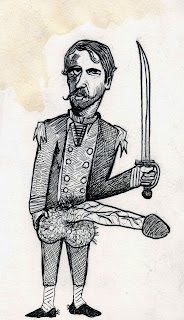

“But why does he do it?” I asked.

“I asked him about it once,” Captain Honesty responded. I says to him, ‘Say, Bill, why come you always add a big ole peeder to every one of them pencil drawrins of yours?’ He told me he done it on account of a nervous affliction.”

“What?” I gasped. “An affliction of the nerves in that immaculate specimen? Impossible!” I asked the Captain just what sort of nervous affliction a man of such upright and masculine bearing and such a nobly sloped forehead as Wild Bill Hickock could have possessed.

“He says it was a habit he had acquired in his schoolin’ days and t’weren’t a thing he could do about it even he had a mind not to.”

“You mean to tell me, Captain,” I shouted, “that Wild Bill is an artist not by his own volition and is slave to uncontrollable and perverse urges?

“Please sir, keep your voice down!” the Captain begged me. “It’s not that Bill’s a madman, sir. Why, he’s as sober as a judge. But Bill wasn’t always a pistol man, you know. ‘Fore he came to the border, he growed up rich back in Baltimore, where his mother schooled him in the fine arts. Even taught him to play the viola. Well, Bill, as you now rightly know, had a fearsome talent for makin’ pitchures. He spent his days out in the gardens of the estate drawin’ neked marble statues or holed up in his daddy’s librurry copyin’ ole pitchures out of dusty ole books. Soon enough, he’d done drawn everything in the whole mansion, so his parents had no choice but to ship him off to Phillerdelphia for proper art schoolin.”

“That’s, as Bill told me, where the trouble begun. ‘When I showed up in Phillerdelphia,’ he said, ‘I fell drop-dead in love with the first girl I seen. A gal prettier than all them Roman goddesses I’d tickled with my pencil back in Baltimore. But there was one problem. She was the Mayor of Phillerdelphia’s daughter.’ Course, the mayor’s daughter fell harder n’ rocks for Bill, too. But the mayor would have none of it. Said he would sooner sell his daughter off to white slavers in Arabia ‘fore he’d give his daughter to a degenerate artist from Baltimore.”

“Course, Bill swallowed the mayor’s venom real calm-like. He just looked him square in the melon till the man shouted hisself hoarse. But then, sure enough, the next day, flyin’ atop city hall, draped over William Penn’s statue was a huge brightly-colored canvas depictin’ the mayor of City Hall neked as a jaybird, abusin’ hisself with the Liberty Bell. ‘Twas the only man who ever insulted Wild Bill and didn’t wind up with a bullet put through his heart. But ever since that day, Bill told me, he’s suffered from his nervous affliction.”

“And you can reckon what happened from there,” said Captain Honesty. “Bill had to skedaddle right quick, for there warn’t no brotherly love left for him in Phillerdelphia. But just to spite the mayor further, he had his daughter meet him one last time for a farewell tryst out in the woods and had her come with the mayor’s prize hoss, Black Nell. Bill kissed his gal goodbye and rode off on Black Nell.

"Now, you can be sure the mayor nearly burst his necktie when heard his best hoss was stolen. He sent his meanest henchmen after Bill. But Bill rode like black lightnin’ across them Alleghenies and by the time they caught up with him, Bill had swapped his paintbrushes for shootin’ irons and was clear over in Kentucky— where I was stationed at Fort Knox. In fact, that were the first time I laid eyes on Wild Bill. I was out on detail in the woods outside Louisville when I see Bill shoot through the clearing on Black Nell just ahead of the mayor’s boys and headed straight for a stone wall. But Bill didn’t slow one bit. Instead he just whispered in Black Nell’s ear, tellin’ her she must jump it; and at it she went with a big rush. I never saw a more magnificent sight. Bill gave the mare her head, and turning in his saddle fired twice, killing both of his pursuers….

March 29, 2011

The Three Joe-kers of the Apocalypse

As our thyroid glands swell with radioactive iodine wafting over from Fukushima and another theater of war lifts its curtains in Libya — sure signs the end times are nigh — we all could use a little levity.

Thankfully, we have the Tea Party.

The new masters of the grotesque spectacle of American politics have given us reason to grin amid the recent flood of war and disaster with their latest announcement: the circus has come to town!

As usual, the Tea Party is in step with history. Circuses have long thrived in an apocalyptic atmosphere, from the lion-feeding frenzies of Rome to the dark days of the First World War, when the Dreamland Circus enthralled the crowds at Coney Island with its three stars: Lionel the dog-faced boy, Ursa the bear girl, and diminutive Princess Wee-Wee.

Last week, America’s latest incarnation of freak show populism upheld this venerable tradition in a jaw-dropping pit show featuring its own prized trio of outlandish specimens: “the Three Joes.”

Past, meet your present-day replacements. Underdog-faced Lionel, meet Joe Miller: Tea Party candidate who lost his 2010 bid for the state Senate in Alaska to a write-in vote. Bearish Ursa, meet Joe Arpaio, the Sheriff of Maricopa County Arizona, renowned for rounding up illegal immigrants, imprisoning them in sweltering makeshift camps, and making them parade around in pink panties. And, finally, Little Wee-Wee, step aside for Joe Wurzelbacher, aka, Joe the Plumber.

Read the rest of this article at HyperVocal.

February 11, 2011

The State Gun and the State Morons of Utah

Well, it’s official. The fair state of Utah is infested with Morons. No, not Mormons. Morons, with a capital M. And here I thought Utah was an anomalous state, filled with ginger-headed polygamists living in red rock compounds with bonneted child brides, but it really is just like the rest of America— which is to say, teeming with gun-crazy morons.

What is worse, many of these morons are serving in the top legislative bodies of our government. The state senate of Utah, exemplary as ever, is thick with them. I think we can fairly gauge the national discourse by the sentiments expressed by Republican state Senator Mark Madsen, regarding yesterday’s final approval of a bill to make the Browning M1911 semi-automatic pistol the “State Firearm” of Utah:

“I think it is a symbol of freedom and empowerment. I think in the balance of history, much more good has been done by free people using firearms than evil done by evildoers wielding firearms,” Madsen said. “I know there is an effort to make it a symbol of negative, I just don’t buy into the propaganda.”

Indeed, let us not overlook the balance of history. Lest we forget the freedom-fighting Spanish conquistadores leveling their muskets at the inhabitants of the New World. Or mercenary soldiers massacring civilians in Central Europe during the Thirty Years War in the name of democracy. Or the liberty-inspired decimation of the American Indians and Australian aborigines. Or all those freedom-loving wars of imperialism in Africa, India, the Philippines, and Indochina. Or the wholesome slaughter of eight million people during World War One.

Fortunately for historical balance, by 1939, evildoers stopped using guns, which had already become widely known by their truer name: “freedom preservers.” Deterred by the potent democratic symbolism of firearms, Hitler and Stalin instead chose to carry out their treachery with bologna sandwiches and paperback books, a trend that has pretty much stuck, right up through Vietnam and the recent drug cartel killings in Mexico. So, hold on, let me do the math… yep, clearly freedom wins.

But, in case we’re not convinced, listen to fellow Utah senator, Republican Chris Buttars:

“Weapons or guns especially are so demonized by certain elements of our society that I think this adds a real balance… .Weapons in the right hands have probably preserved freedom time and time and time again.”

Not just “time and again,” mind you, but “time and time and time again.” Because, to fully appreciate the freedom-producing powers of handguns, you have to take the longue durée view.

Senator Buttars apparently attended the same history class (and skipped the same introduction to the English language class) as Senator Madsen. The same class, it seems, that all Republicans have attended—the one where you learn to dress up garbage thoughts as a time-honored tradition, turn an enfeebled mind into a symbol of patriotism, and memorize the following rhetorical equation: guns + history /balance = freedom.

Of course, it’s hard to think of the last time I read in the news an account of a freedom-loving citizen with a gun shooting a deranged killer dead in his tracks and preventing a would-be massacre like the one last month in Tuscon. That’s the fantasy—of the armed hero springing into action when evil strikes—that is fueling not only Utah’s crayon-and-drool desire for a state gun but a whole spate of less symbolic and more disturbing legislation around the country.

Texas, Florida, and New Mexico legislatures are considering bills to legalize guns on college campuses, while Nebraska is voting on whether elementary and high school teachers should be authorized to wear concealed weapons in the classroom. Michigan and Iowa are looking to join states like Arizona and Tennessee that allow people to wear concealed or holstered weapons virtually everywhere, even in bars. Every state but Illinois and Wisconsin has conceal-and-carry allowances, and that looks like it might soon change. At a time when we urgently need to reflect on our culture’s irrational obsession with guns, our politicians seems to be reacting to the latest tragedy in Tuscon by fleeing into the solace of schlock hero fantasies, as throughout the country they try to re-enact “Die Hard” on the senate floor.

An armed populace of cool-headed, upright John McLains would be one thing. But Americans need to face the fact that they have a high-density population of morons in their midst. Not flat out deranged or malevolent morons, mind you, but those exhibiting the kinds of thought processes that unfold so naturally in the heads of Senators Buttars and Madsen. The kinds of thoughts that make you shudder to know that particular person is carrying a semi-automatic pistol in their holster.

What is to be done? Here, I think the Mormons—not the morons—of Utah can be of service. In past visits to their comely state, I’ve noticed that in restaurants where alcohol is served, a line on the floor separates the safe alcohol-free family atmosphere from the perils of intoxication posed by the “private club.”

I propose we institute a similar law with regard to guns. Let the freedom-loving patriots exercise their distorted constitutional right to feel cold steel on their crotch at all hours of the day, in church, at the bar, in the hospital, on the highway, on the senate floor—just make sure it is on the designated side of a line, partitioned by bullet-proof glass.

December 22, 2010

Holiday Status Updates: Heathrow Airport


December 21, 5:50am:

Worst news ever. Flight has been cancelled. Huge snow storm. Horrendously long lines— in one of them now, hoping to get on the 2:30 flight to Copenhagen and catch connecting flight home tonight.

December 21, 9:33 am:

Still in line, moving painfully slow. Someone in the family in front of me has a case of the farts. Annoying. I bet it’s the chubby kid. It’s always the chubby kid.

December21, 10 am:

Not going to Copenhagen. But guess who is? That’s right, little mister fartface and his whole slob family. Blood pressure rising. Need a Cinnabon.

December 21, 10:13am:

Line at Cinnabon of unspeakable length. Don’t care—right now this glutinous mound of fat is more important to me than seeing my family.

December 21, 11:30am:

Got 10 Cinnabons, just in case. Ate three, stowed six in my carry-on, used one to bribe the lady monitoring the line at the United ticket counter. Got a spot near the front. Feeling pleasantly engorged. Staying optimistic.

December 21, 12:02am:

Unfuckingbelievable. I think my spleen is ruptured. A group of Australians behind me saw my greased transaction with the line lady and went mad max on me. They must have burst an insulin clot when they were shoving me to the back of the line. I don’t mean to sound bigoted, but Australians are the most brutish people in the world. And the ugliest.

December 21, 3:45pm:

Really wish I brought something more to read than the December issue of Details. Don’t get me wrong. Great magazine. I owe everything I know about performing world-class cunnilingus as well as my prized pair of eyebrow tweezers to their staff of writers. But reading it in public makes me feel kind of like a—how-do-you-say—oh yes— moron.

December 21, 5:30pm

So bored. So tired of hearing CNN on the monitor above me. So death squads are terrorizing Ivory Coast, but do you have any idea how long I’ve been in line? I’m trying to get home for Christmas, so don’t burden me, Anderson Cooper, with your lament about death squads.

December 21, 7pm:

Great. No flights today. Ticketing agent said my best option is to sleep overnight and see if I can get placed on something tomorrow. Said the wait might last a few days, possibly until after Christmas. Does anyone know the best place to sleep in Heathrow?

December 21, 9pm:

Thanks for the tip on the ventilation shaft by baggage claim 4. Have made a cozy bed in here with clothes from my suitcase. Just feasted on a couple more Cinnabons and am quite engrossed in Details’ investigative piece on male cheerleading. Have a feeling tomorrow will be better.

December 22, 1:52am:

Hey, how many people did you tell about the ventilation shaft?! Seven more have shown up and we’re at capacity. A German accountant is leering at my carry-on. He must smell the Cinnabons. If he touches them, I will destroy him.

December 22, 9:33am

Spirit broken. Fell into stink- and heat-induced sleep coma, overslept, and awoke in the arms of the German accountant. Pretty sure there’s frosting on his lips. Kicked him in the neck out of suspicion. Ran to the ticket counter, where the line was already out the door and snaked into the short-term parking garage.

December 23, 10:12am

Realized I forgot my luggage, with wallet in it, in the ventilation shaft. Sprinted back in cold sweat. Nothing. Frantically searched for airport security and related my story. Airport security guy asks what I was doing in a ventilation shaft in the first place. He wants me to go with him to answer a few questions.

December23, 7:00pm

Now I know—in airport security jargon, “answer a few questions” means “answer a few questions while a gloved finger wiggles around in your anus.” I will never complain about the TSA body scan again. Thank god, have been released.

December 23, 11:08pm

Spent the last four hours ravenous— loitering in duty free in vain attempt to pocket candy. Every fucking thing is oversized! Store clerk picked up the phone when she saw me trying to stuff a jumbo Toblerone and a handle of Chivas down my collar. Left empty-handed in a panic. But, by stroke of luck, found a bonanza of Auntie Anne’s pretzel cheese in an overflowing trash bin near Delta counter. No Cinnabon, but it’ll do.

December 24, 3:19am

So cold. So scared. Will I ever get out of here?

December 24, 4:06am

Tormented by a single unrelenting thought: what if that wasn’t pretzel cheese? Of course it was, I tell myself. But then my devil voice whispers: well, then what was it doing in a pile of diapers?

December 24, 7:30am

Sleepless night, but I conquered my demons. Queued up at United ticket line before dawn, resolved to make it home, even if it’s the day after Christmas. Realized I still had a photocopy of my passport in my pants pocket. There’s still hope!

December 24, 1:23pm

Hallelujah! Finally spoke to the ticket agent who accepted my passport copy and booked me on a flight to Madrid tonight, arriving home Christmas morning! Save some eggnog for me!

December 24, 5:40pm

Made it through security, plane has arrived, about to board. Hey that’s funny— that sounds like my name being called on the intercom.

December 24, 6:02pm

Name definitely being called on the intercom.

December 24, 6:09pm

They found my bags! Lady at the gate told me sweetly just to wait at the counter and someone would come for me. Guess everything always works out in the end.

December 25, 12:03am

Tried to tell them it was just icing, you know, from a cinnamon roll. But they couldn’t understand why I would line the inside of my carry-on with icing, nor why a normal cinnamon roll would have so much icing, especially one with such high levels of silicate residue. It’s no normal cinnamon roll, I told them, it’s a Cinnabon, and I had six of them in there. That’s absurd, they said. No one eats six Cinnabons, besides, we didn’t find any cinnamon rolls in there. Damn that German, I screamed, tears welling up.

It’s ok, they told me. Why don’t you come with us and answer a few questions.

November 19, 2010

Public Libraries: A Public Adventure

“Sancho followed on foot, leading is donkey — his perpetual companion in prosperous and adverse fortune….” — Don Quixote

In these threadbare days, what kind of future do we foresee for that homeliest and homiest of institutional beasts, the public library? It is surely the donkey of the American cultural menagerie-toothy, overworked, belittled, yet stubborn to the point of endearment. How else, other than out of sheer stubbornness, can we account for the fact that libraries continue to supply communities all over the country with books… made of paper…to the public… for free?

But for residents of Santa Clarita, California, this persistent belief in community education in the age of the bottom line may at last be coming to an end. Thanks to the city’s controversial vote to outsource its libraries to a private for-profit company, the donkey may be going the way of the dodo.

Santa Clarita is only the latest town to consider privatization. Currently, fourteen library systems comprising 63 branches are already operated by a company with a villainously generic name, Library Systems and Services (LSSI). Of course, this great whoring out of one of the cornerstones of democratic civil society ought not come as a surprise. Libraries reek of government and if there is one thing so many of our governing American politicians hate, it’s governance.

The most decried issue by those fighting the specter of LSSI in Santa Clarita concerns the likely replacement of salaried and pensioned municipal employees with cheap non-union labor. The head of LSSI made remarks in The New York Times this fall accusing public librarians of being rich and lazy. Apparently, whenever you see a librarian scanning his computer screen, they are not helping people access information but checking the soaring dividends on their pensions.

Beyond the inevitable union busting, privatization of libraries could bring a subtler yet even more insidious anti-democratic change: the removal of the public from the public library.

The central branch of San Francisco Public Library is a carnival of humanity. I used to work next door to the central branch at Civic Center and, I can assure you, the library is not only home to the unwashed masses; it’s where some of those masses go to wash. In one of my many memorable trips to the lobby bathroom, I saw a man washing his shoes in the sink, the fellow next to him brushing his teeth, and, in the corner, a less hygienic soul conversing with the air dryer. On a subsequent visit, I witnessed a showdown between two men in the doorway of a stall. One was accusing the other, in no uncertain terms, of defecating on the toilet seat.

I’ve studied next to a man who took frequent breaks to stretch his quads and make high-pitch screams, as well as a wretch who incessantly cleared the phlegm in his throat to such revolting effect that I nearly gave up on life. And often when walking by the hallway bank of derelict payphones, I’ve come across a cane-wielding retired geisha giving the stink-eye to passersby as her brothel rouge slides down her jowls.

While, in an ideal world, I could do without the scream breaks and the soul-shrinking phlegm rattles, I embrace the library as a radically inclusive community space. That a substantial part of downtown San Francisco’s community is indigent and mentally ill is perhaps another matter. The public library should be available to everyone in the spirit of a civic refuge and forum. Like a donkey that dutifully bears the burden of humble peasants and mad hidalgos alike.

A private for-profit public library is a contradiction in both name and ethos. With that murky designation, a host of equally murky and unsettling questions arise. Would a private library, like other private businesses, have the right to refuse service to anyone? Would a private library, to cut costs, reduce the diverse and community-specific nature of their collection? Would a private library, in the spirit of corporate synergy, pedal certain types of publishers over others? How would a private company handle access and protection of patrons’ library records?

One thing is clear: once a profit motive enters the picture, serving the public becomes a means not an end.

The good news is there are currently 16,549 public libraries (including branches) in America. According to Leonard Kniffel, editor and publisher of American Libraries, this country has, astonishingly, more libraries than McDonald’s restaurants. Let’s keep those libraries public, in name and deed.

We certainly have a better shot at that than my other idea: nationalizing McDonald’s.

November 1, 2010

Behind the Smoke of the Marijuana Legalization Debate

(This piece was also published at When Falls the Coliseum)

This coming election day, with the proposition on the ballot to legalize the small-scale growth, distribution, and possession of marijuana, we in the golden state have the chance to repeal an outdated law that has done too much harm for too long. Unfortunately, the current debate surrounding the prospect of legalization obscures the simple heart of the issue at stake.

I said the law was “outdated,” but the prohibition of pot was never the right answer for its time. Only its motives were clearer. The first states passed anti-marijuana laws in the twenties during Prohibition (strange how alcohol is such a vital part of our culture that we can characterize an era by its absence). The criminalization of pot emerged in an age in which legislators and courts thought the consumption of alcohol posed too great a burden on society to be considered an inalienable right of liberty or property, as protected under the First and Fourteenth Amendments of the Constitution. Marijuana, its detractors worried, would become the substitute narcotic in that period of unquenchable thirst. But we have since come to feel differently about the freedom to consume alcohol, despite recognition of its potential dangers.

When the first federal law against the drug, the Marijuana Tax Act of 1937, was passed, most Americans had still never heard of the drug. Why? Because the law targeted the practice of a specific demographic, itinerant Mexican workers, who were immigrating in greater numbers to the south and west of the country. In other words, the prohibition of marijuana proceeded under the radar of public opinion because, unlike the prohibition of alcohol, it targeted a demographic that no one who was then considered part of ‘public opinion’ cared about. Meanwhile, the blatant unconstitutionality of the law could be ignored in the face of fear-mongering claims about the drug’s effects, which produced criminal depravity, insanity, and other gangrenous blights on the social body.

In the fifties marijuana became a household name, known mostly as a drug of questionable urban types — blacks, Latinos, poets, and jazz musicians — that, without strict prohibition and stiff prison terms, would infect white youth. Despite the draconian measures, in the sixties and seventies, those fears came true.

Fortunately, as a result, the discourse has moved beyond the myths of reefer madness. This is due less to the recent scientific and medical studies that have been marshaled in support of the benefits of marijuana and more to the simple fact that many Americans under sixty-five now have first-hand empirical understanding of the positive and negative effects of the drug — not something you’d want to smoke right before you operate a submarine, but unlikely to turn you into a frothing rapist.

Instead, the opposition today, no longer able to embellish with quite the same high moralist rhetoric of yore, voices supposedly practical objections. They complain about the great tax burden that would come from legalization and its incurred medical costs. Guess what? We already incur those costs, whether or not pot is legal. They complain about youth having easy access to the drug. Again, this is already the status quo. According to one study, teenagers have an easier time getting black market marijuana than they do liquor on the shelves.

At a recent conference in Cartagena, Colombia, Latin American leaders condemned California’s Proposition 19, claiming the legalization of marijuana in the United States undermines their war against drugs and mocks the tragic nature of the narcotics industry in Latin America. But legalization will only further emphasize, perhaps painfully, the senselessness of the violence associated with the cultivation and distribution of this plant and the futility of the war on drugs.

Yet the supporters of legalization are also guilty of obscurantism in this debate. They tout the supposed social benefits legalization will bring by striking a blow against the prison industry, ending the cycle of poverty and jail, helping defuse the violence of the Mexican drug cartels, and creating state revenue for education. Certainly the laws against marijuana and the way they have been enforced by police and prosecutors have helped to destroy black and Latino communities and fund an industry of incarceration. But legalizing marijuana is not going to fix those problems. And legalizing marijuana in California is not going to quell the bloodlust of the Mexican drug cartels. I’m also skeptical legalization is the key to solving the problem of California’s education system.

The truth is we don’t know what the effects of legalization will be. We have to wait for the law of unintended consequences to show us. But we do know that it is both high time and just to do away with a law that infringes upon a basic civil liberty — the freedom to exercise sovereignty over one’s mind and body. John Stuart Mill, in his stunning and still relevant 1859 treatise On Liberty, put in pithy terms what has come to be known as the principle of negative liberty:

The only purpose for which power can be rightfully exercised over any member of a civilized community, against his will, is to prevent harm to others. His own good, either physical or moral, is not a sufficient warrant. He cannot rightfully be compelled to do or forbear because it will be better for him to do so, because it will make him happier, because, in the opinion of others, to do so would be wise or even right. These are good reasons for remonstrating with him, or reasoning with him, or persuading him, or entreating him, but not for compelling him or visiting him with any evil in case he do otherwise.

The legalization of marijuana aims to recover this principle of negative liberty from nearly a century of violation. Proponents of legalization should keep their utopian visions in check, for they risk making a simple issue of negative liberty, concerning a trivial act of personal pleasure, into a vehicle of social reform. The repeal of an irrational and unjust law, insofar as it constitutes a critical revaluation of our own past and a respect for the civil liberties that this country prides itself on, is a social reform in itself.

October 15, 2010

Ohio Historical Reenactment Society Newsletter

Dear fellow living historians,

Another year is fast becoming history — pun intended! — and we have been busier than ever. Before it slips away, let us take a moment to congratulate ourselves on recent successes and sneak a peek at the exciting new historical events just around the corner.

This past March, we kicked off our season with the fifth annual shelling of Sarajevo. Living historians took to the hills outside Youngstown to bring to life those early days of the Bosnian War. A harrowing ordeal, of course, but from a military re-enactment perspective a veritable hoot. Clad in the full regalia of the Republika Srpksa and the JNA, historians swigged non-alcoholic slivovitz and rained down empty mortar shells on unsuspecting Youngstowners, teaching them a history lesson they won’t soon forget! The legendary Ron “Swifty” Gibbs of Swifty’s Auto Repair in Akron deserves special kudos for his performance in the role of Serb nationalist leader Radovan Karadsic. He masterfully expressed Karadsic’s proud patriotism and fierce determination in the face of battle(without any ethnic hostility, of course). Way to go, Swifty!!

After a long winter, April’s bombing of Guernica helped bring spring to Ohio. This event, which coincided with the Greater Cincinnati Air Show, turned out to be a real crowd pleaser — a notable contrast to last year’s bombing of Pearl Harbor. And who could be surprised, with the prowess shown by the living historians of the Cincinnati Condor Legion. As predicted, they utterly demolished the boys of the Louisville Basque Civilian Brigade. Just like we demolished all those tasty paella wraps Beverly Delmonico served after the bombing. Thanks Bev!!

Summer had us running around with our heads cut off, as usual. Our Days of Summer Armenian Genocide was the educational bloodbath Ohio citizens have come to love, but, as always, a heck of a lot of work. Cease and desist letters from both Armenian advocacy groups and the Turkish government continue to create a lot of red tape, making it difficult for our historians to channel the hearts and minds of our historical subjects. On an even more tragic note, we lost two beloved historians to heatstroke during the massacre. Reginald DeWitt of Canton, aka Turkish bludgeoner #47, and Huey Liddersworth of Dayton, aka Armenian shopkeeper #18, were honorable men and accomplished historians who died fighting for what they believed in. Fallen heroes, we salute you.

As winter approaches, we turn our attention to the frozen tundra of the Eastern Front, 1941. We are still looking for new recruits to join our Einsatzgruppen SS for our December staging of Operation Barbarossa at Uncle Boone’s Turkey Farm, just outside Toledo. If you know any living historians or aspiring living historians who would like to join our well-trained corps of loyal commandoes as they cruise through Belarus on special missions to fight cultural bolshevism, please email Randy Nesbit (randytnesbit@cheapsuntansrus.com). Attention: The Ohio Historical Re-enactment Society in no way endorses, for better or worse, the ethos of National Socialism. We are historians who enjoy studying the past by dressing up and pretending to be soldiers from history. We emulate courageous warriors who fought for ideals, however unsavory those ideals may have been, or however they may have been distorted by the liberal media. If you are a looking to join the Einsatzgruppen SS out of belief in the tenets of National Socialism, you are looking in the wrong place. If, however, out of sheer love of history, you would like to dress up and pretend you are a soldier in a mobile killing unit targeting Jews, Gypsies, and members of the Soviet intelligentsia - then welcome aboard, historian!

Speaking of Nazis, which we are not, we just launched a new program. Our community youth outreach program in the living history of the Third Reich educates youngsters about the fascinating (though, admittedly, delicate) institution of the Hitler Jugend — the boy scouts of 1930s Germany! Through our innovative pedagogical commitment to experiencing history first hand, we show students what a care-free Aryan childhood was really like. First, we demonstrate how they would have been selected for HJ membership through rigorous genealogical blood purity analysis. Not only do the kids learn history-they practice adding fractions! Then, as a learning simulation, we put them through an intensive ideological indoctrination process (minus the anti-Semitism of course!), teaching them the relevant values of self-sacrifice, love of country, and the importance of monitoring family members for signs of cultural bolshevism. This year’s program will culminate in a gymnastics exhibition and flag ceremony (minus the swastikas of course!) during halftime at the Fremont Cougars homecoming game, November 18th. We encourage all you historians to don your costumes and come fill the rostrum!

Two last announcements: Susie Orstmeyer is organizing a bake sale and car wash to raise funds to build a full-scale compound in Columbus for next summer’s staging of the Branch Davidian showdown at Waco. Auditions for the role of David Koresh will be announced in February. And, finally, just a reiteration of last newsletter’s call for living historians: if anyone knows anybody of brownish hue — Hispanics, blacks, Arabs, or even the right kind of Asian or Jew- Herb Jennings is hoping to reenact the Battle of Algiers in the spring, but is having a heck of a time fielding the Algerian side.

Well, historians, that’s all the news I got. The rest, as they say, is history — pun intended!

Yours sincerely,

Rich Iott,

Living Historian
Candidate for Congress, 9th District Ohio


(This piece can also be read at When Falls the Coliseum)

August 4, 2010

The Pap of Progress

(The following can also be read at When Falls the Coliseum.)


In the last embarrassing installment of the “The Conversation,” the New York Times’ pandering online ‘dialogue’ between columnists David Brooks and Gail Collins, readers overheard David and Gail chatting philosophical on the progress of humanity. Regardless of the deplorable state of American, well, everything, they assured each other in alternating heaves of optimism, at least the present is better than the past.

Not that we should be surprised. David Brooks could find the silver lining of industrial capitalism in a radiation cloud. Nuclear technology, after all, is clear evidence of economic growth and human creativity. No, we shouldn’t be surprised that this country’s supposed intellectuals are finding new ways to dumb down discourse with rancid chestnuts about progress. But we should be disappointed.

The old progress versus decline debate is usually an impoverished one, especially when the parties end up cheering for the upward march of history based on the greater availability of nifty telephones. Case in point, Brooks:

Nevertheless, I’m pretty sure living standards will continue to surge, as they have for everybody for a century or more. Gizmos will get cheaper. New technologies will sprout. Luxuries will be considered necessities.

I cannot understand what qualitative measure of progress is gained when luxuries become necessities. The equation of human progress with technological development rests on the assumption that more sophisticated ways of manipulating our environment and organizing knowledge amount to an increased ability to satisfy human need. But doesn’t the transformation of what was previously a luxury into a necessity increase human need only further?

Contrary to what advertisers want us to think, sprouting technologies will not make our lives better. They will simply change the circumstances in which we lead our lives. And that transformation can be felt as a loss or a gain, depending on what one values. I see no hope for a resolution to the problems facing America and the world in the fact that “gizmos will get cheaper.” If anything, our tendency to convert luxury into necessity will make those problems more acute. But David Brooks, like so many Americans, is too enthralled with the warm glow and supple buttons of his BlackBerry to notice. I expect this kind of delusional pap from the people who line up three days early to buy the first batch of iPads. But should I really expect to read the same idiotic sentiments in the pages of a respected newspaper?

In an earlier “Conversation” column this year, Brooks attempted to refute the idea of America in decline, claiming that theorists of the disintegration of Western civilization have always been mistaken because, voila, look what’s still here, Western civilization. In his muddleheaded conflation, America’s status as supreme global economic power and the continuing existence of that unwieldy cultural-historical entity we call Western civilization were one in the same.

Forget for the moment the hot topic of America’s decline in the world order and consider instead Brooks’ underlying denial of the idea of decline per se. “Every previous bout of declinism has been disproved,” said Brooks. He failed to elaborate, but even if we accept that talking about decline in any objective sense is unreasonable, then shouldn’t we say the same about progress? Isn’t the very idea of a single all-encompassing directionality to history absurd? History is human activity and the interpretation of said activity. How could the movement of such a phenomenon--either the activity or the interpretation—be anything other than flux in all directions?

Just because we still consider ourselves nominal heirs to a cultural tradition called the West- - a myth of identity whose origins we often place in the eighteenth-century nexus of Enlightenment, French Revolution, and the Industrial Revolution, with Renaissance and Greco-Roman antecedents—doesn’t mean the values of that tradition actually persist. Increasingly, our sense of historical identity is a facade, a rhetorical gesture intended to disguise the fact that an abyss separates our present from the past that we call our own.

This feeble rhetorical spackling is on display in “The Conversation” where columnists masquerade as men of letters. Gail Collins refers to Voltaire’s novel Candide as “that play.” David Brooks and Dick Cavett, in an abortive attempt at comparing America to Rome, can only guess at what Edward Gibbon must have said in that big old dusty book of his. The best Cavett can muster is that he knew one person, Gore Vidal, who had actually read it. It becomes painfully clear that if we want to read anything incisive about American politics and culture in relation to Rome, we’d better get the hell out of this ‘conversation’ and go find Vidal.

In the meantime, until they have a better grasp on the past and are capable of measuring human well being in something other than gigabytes, pundits ought to refrain from reckoning either the progress or the decline of civilization.